

Clare Heath-McIvor here! A few people have asked me this same question of late: do Evangelicals really believe we are living in the end times?
Short answer? Dude. Yes.
Long answer? Let’s go.
I’m speaking here about Evangelical Christianity as an aggregate. Not an individual church. If you look, logically, at history, we can see that empires have risen and fallen. Volcanoes have erupted. Earthquakes have happened. It seems like every generation since Jesus has believed to some degree that it was the last, and that Jesus would return soon.
I asked a Jewish-Christian friend about this, making my point that surely we could all get behind the interpretation that the book of Revelation was either apocalyptic fiction, written by some “OTHER” John, or an allegorical commentary on the Roman empire’s mistreatment of the Jews and thus…sorta…done.
Her response was that as a Messianic Jew, she was taught to view time as like a DNA double helix placed horizontally. That cycles would occur around these themes until an ultimate completion. Her belief was vehemently opposed to mine. Revelation is not done yet.
Now, I’m just talking about one person’s views, but the helix interpretation of time and prophecy is one I’ve since heard repeated. So lets take that and look at some big themes in the book of Revelation.
First up: the rapture.
This is the belief that Jesus Christ will return in two phases.
First, he will come back for believers both living and dead and call them up into the sky. It was prophesied as happening back in September, even though the scripture says no man knows the day or the hour. Maybe the women can know? Or maybe it’s been postponed until later.
I always believed this was literal and imminent, and it is certainly a belief held by large chunks of Christianity. However, I only just found out this week that a guy came up with the rapture theory in 1827 – the same year he fell off a horse and sustained a head injury.
The rapture is supposed to be followed by a bleak and terrible time in history called the Tribulation. This is where the second theme comes in –
The four horses of the apocalypse portrayed in revelation 6.
The four horses represent four catastrophes that are thought to precede the second coming of Christ. While not specifically named in ancient texts, they are widely interpreted as being the Antichrist (or Conquest). War, Famine, Death.
Let’s start with the easy one:
Death and Pestilence:
It’s bleak, but the COVID-19 pandemic has been shown in research to have triggered end times, or existentially related, dread. Scour the internet for a few minutes, and you’ll see it too. The death count, the impact on economic security, mental illness, relationships etc. This is seen by some as a pestilence and death horse riding.
Next is famine:
Poverty and wealth inequality has been a reality since Moses was a boy (and probably much longer). One could ask why American Evangelicals and adherents to similar strains of faith aren’t too fussed with wiping out poverty and wealth inequality so much as proselytising, or even why they don’t seem to care about climate change, with many even denying the science? Could be that they are seeing an inevitability in it. Another of the four horses signalling the imminent return of Christ.
Then there’s war.
And wow. Didn’t the war in Israel land a sucker punch here? A topic all on its own, but in Christendom, there is a belief that Israel is the only nation on earth created by a sovereign act of God, thus belonging to God himself. There is also a belief that Israel and the Jewish people are a sort of cosmic barometer for spiritual activity. I.e. Pray for the peace of Jerusalem, for in doing so you pray for the peace of the world. Another interpretation is that Israel is a prophetic picture of what is coming to the world – a divine prophetic picture.
I simply cannot, in one video, trace the origins of religious Zionism. But there is a reason that huge chunks of right-leaning politicians throw their weight unequivocally behind Israel, regardless of the incredibly complex and fraught and terrible and gutwrenching things that have gone on – including those perpetrated by the Israeli side of the war. To them, if you fight Israel, you fight God.
That doesn’t mean some sections of the extreme right don’t also manage to hold a contradictory, anti-semitic view. After all, Hitler was Christian. Let’s talk about THAT cognitive dissonance another day.
Then there’s the first horse, which I’ve left until last. It is broadly described as the Anti-Christ.
While the Anti-Christ is thought of as all sorts of things – a person, a spirit, a phenomenon, there is plenty of room for evangelicals to cherry pick the evidence around them and see this horse coming at them.
Social progressivism? Anti-christ.
LGBTQA rights? Anti-Christ.
Gender-affirming care, reproductive rights, no fault divorce, lack of female submission to men, sex outside of marriage, left wing media, entertainment, music artists, celebrity culture, people treating sport ‘as a religion’.
I could go on. I really could. But I’m trying to keep this post short.
Inside fundamentalist evangelical churches today, I’m seeing (in articles) and hearing (in podcasts and sermons) a firm belief that these are the last days. That Jesus is returning soon and we need to get ready. I’ve been hearing these all my life, but its likely to be reaching fever pitch now as all this stuff goes on in the world.
The big question then: what do Christians do with this information?

The simple answer is they push their views with increasing urgency based on the belief that they are running out of time to save us from eternal conscious torment in hell.
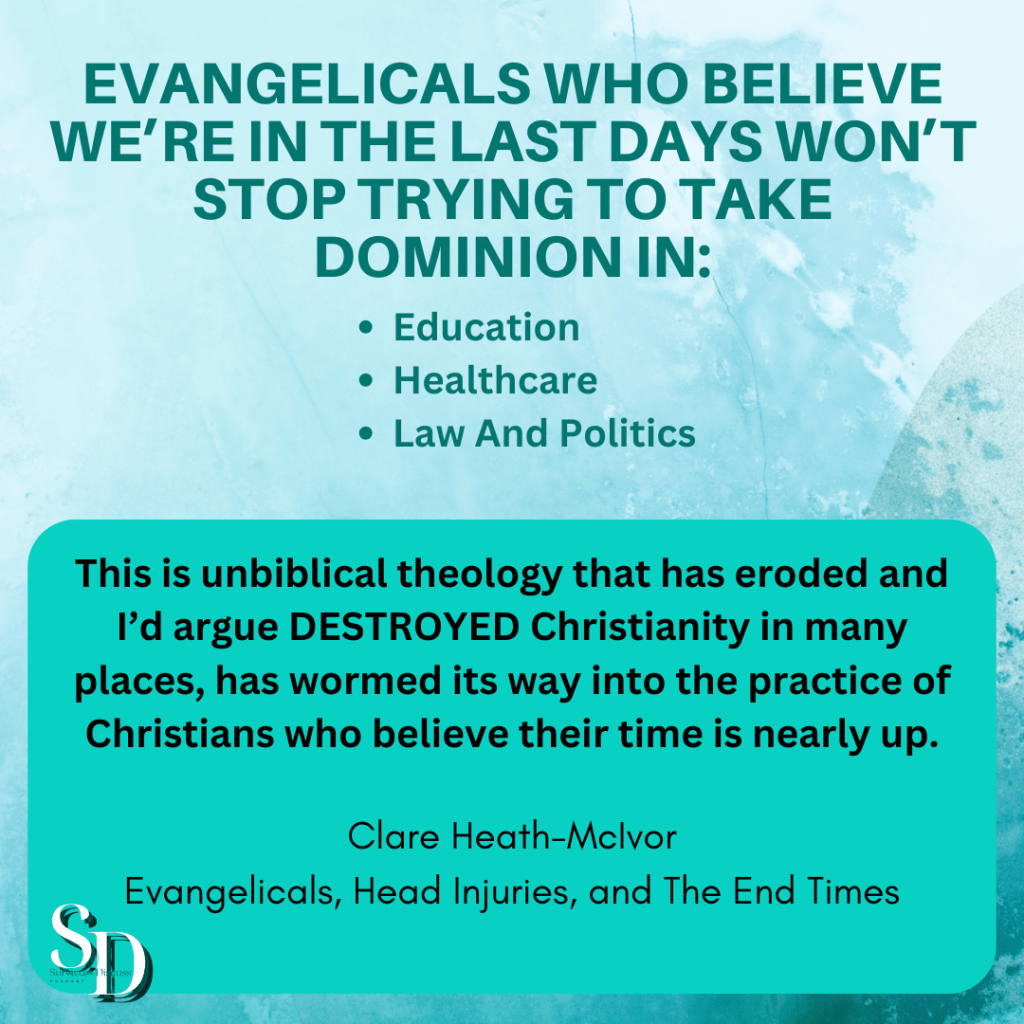
This is where dominionist attitudes – trying to take dominion where decisions are made and change can be created – are paramount. This is where the means will not matter as much as the end – salvation to us heathens, our adherence to the Christian faith, and the bringing about of God’s government on earth.
They won’t stop trying to take dominion in education. We see it in complaints against safe schools programs, respectful relationships, and claims of indoctrination of children.
They won’t stop trying to take dominion in healthcare. We saw it this week in the motion for an enquiry into gender-affirming care for trans kids by an anti-trans politician. We saw it in the states with the overturning of Roe v Wade and with individual states enforcing abortion bans.
They won’t stop trying to take dominion in law and politics. In the US, No fault divorce is currently an issue to watch. In Australia, we are trailing behind them in what looks to the reasonable person as a disaster for human rights as women and other genders are denied fundamental rights to healthcare and human agency. We see it as countries and states try to fight LGBTQA conversion therapy bans
The other areas for seven mountain dominionism, a pervasive but unbiblical theology that has eroded and I’d argue DESTROYED Christianity in many places, has wormed its way into the practice of Christians who believe their time is nearly up.
Yes. People believe the return of Christ is near and the recent events signal it.
So that is an uncomforting, even disquieting answer to the question.
Yes. Large chunks of the right-wing church believe Jesus is coming back soon and are very likely to behave with increasing urgency when it comes to peddling and enforcing their beliefs.
What do the rest of us do?
We don’t assume progress is a given. We don’t assume reason will win the argument. We keep up our advocacy, our allyship. We wrap our arms around those who are deconstructing or have deconstructed their faith, and who may see this time with increasing anxiety and even fear.
And to those people, I’d say John Nelson Darby first proposed and popularised the pre-tribulation rapture in 1827, the same year he hit his head really hard.
Follow unchurchable everywhere you get your podcasts for more helpful information than this. You can also find me on the interwebs.
I got you.
-Clare
 Survivors Discuss Podcast
Leave a comment